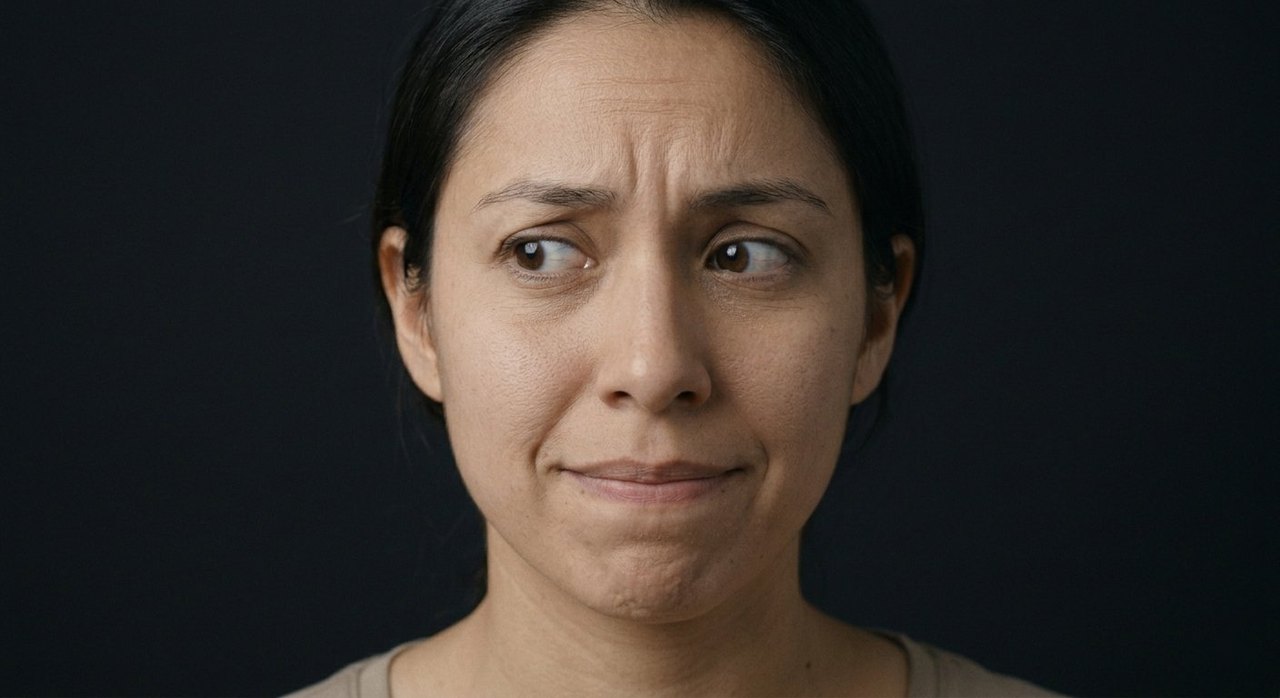
Anxiety
Persistent worry about what might go wrong.
Anxiety is persistent worry about what might go wrong. The body braces for something that has not happened, and may never happen. Fear has a target you can point at. Anxiety often has no clear object, yet the body still reacts.
Your body is not lying. Your story might be.
Anxiety is not a malfunction. It is a body trying to protect you with old information. The racing heart, the shallow breath, the scanning mind. These were once the right answer to a real threat. They are now the wrong answer to a future that has not arrived. The work is not to silence the alarm. The work is to thank it, then check the room. Place a hand on your chest. Name five things you can see. Say out loud: I am here. The threat is not. The body cannot be argued with. It can only be shown, gently, that this moment is safe.
"Anxiety's like a rocking chair. It gives you something to do, but it doesn't get you very far."
— Jodi Picoult
Anxiety is a whole-system response. The body is preparing for action that is not coming, which means the activation has nowhere to discharge. This is why anxiety feels both intense and stuck.
Research on anxiety has consistently shown autonomic activation: elevated heart rate, faster breathing, increased muscle tension, and gut motility changes (Hofmann et al., 2012). The Nummenmaa body-mapping study found anxiety produced sensations across the upper torso and head, with reduced sensation in the limbs, distinct from anger (which lights up the arms) and sadness (which dims the whole body).

Anxiety is a signal, not a malfunction. It evolved to keep the body alert to potential threats. The trouble is that modern life produces few physical threats and many ambiguous social, financial, and existential ones, which the system was not designed for. Common patterns include:
Anxiety responds to slow inputs more than to fast ones. Trying to think your way out usually makes it worse, because thinking is part of the loop. The following practices are not cures but interventions that lower the volume.
Slow the breath, not the thoughts
Lengthening the out-breath signals safety to the autonomic nervous system. Inhale for four counts, exhale for six or eight. The thoughts will continue. The body will settle anyway. This is the single most evidence-supported anxiety intervention you can do without help.
Move the body
Anxiety is unspent activation. Walking, swimming, or any sustained movement gives the chemistry somewhere to go. Twenty minutes of moderate movement reduces anxious arousal measurably (Anderson and Shivakumar, 2013).
Name the worry, write it down
Worries held in the head expand. Worries written on paper shrink. Five minutes of writing what you are anxious about, without trying to solve it, often reduces the intensity. The act of externalising completes a loop the mind keeps trying to close.
Limit the inputs
News, social media, group chats, and notifications all feed anxiety. Reducing input volume, especially first thing in the morning and last thing at night, often produces more change than any specific technique.
If it is chronic
Anxiety that persists for months, interferes with sleep, work, or relationships, or includes panic attacks is worth taking to a GP or therapist. Cognitive behavioural therapy and certain medications have strong evidence. You do not need to white-knuckle this alone.
"The body cannot tell the difference between a real threat and an imagined one. Both produce the same chemistry. Both demand the same recovery."
— A common observation in trauma and anxiety research
What is the difference between anxiety and fear?
Fear has a specific object that is present and threatening. Anxiety is fear without a clear target, often pointed at something that has not happened yet. Both produce similar bodily activation, but anxiety tends to last longer because there is nothing concrete to either fight or flee from.
Where do people feel anxiety in the body?
Most commonly in the chest (tightness, fast heartbeat), the stomach (knotting, churning), the head (pressure, racing thoughts), and the shoulders (drawn up, tense). The arms and legs often feel restless rather than activated, as if energy is trapped without an outlet.
Is anxiety a mental illness?
Anxiety is a normal emotion that everyone experiences. It becomes a disorder when it is persistent, disproportionate to the situation, and significantly interferes with daily life. The line between normal anxiety and an anxiety disorder is clinical, not categorical, and is usually diagnosed by a GP or mental health professional.
Why do I feel anxious for no reason?
Anxiety often has no obvious cause because the trigger may be subtle, accumulated, or internal: poor sleep, caffeine, unprocessed stress, hormonal changes, or a learned pattern reactivating. The mind then searches for a reason and may attach to whatever is currently in awareness, which is not the actual cause.
How long does anxiety usually last?
Acute anxiety episodes typically peak within 20 to 30 minutes if not fed by avoidance or rumination. Generalised anxiety can persist for weeks or months and usually requires intervention to shift. Anxiety that comes and goes without disruption is normal. Anxiety that stays is worth addressing.
- Hofmann, S. G., Asnaani, A., Vonk, I. J., Sawyer, A. T., & Fang, A. (2012). The efficacy of cognitive behavioral therapy: A review of meta-analyses. Cognitive Therapy and Research, 36(5), 427–440. https://link.springer.com/article/10.1007/s10608-012-9476-1
- Nummenmaa, L., Glerean, E., Hari, R., & Hietanen, J. K. (2014). Bodily maps of emotions. Proceedings of the National Academy of Sciences, 111(2), 646–651. https://www.pnas.org/doi/10.1073/pnas.1321664111
- Anderson, E., & Shivakumar, G. (2013). Effects of exercise and physical activity on anxiety. Frontiers in Psychiatry, 4, 27. https://www.frontiersin.org/articles/10.3389/fpsyt.2013.00027/full
Anxiety sits in the fear family but has its own neighbourhood. The other entries are mostly distinguished by what they fear and how acute the response is.
See where anxiety sits among the other 402 emotions.
Open Anxiety on the wheel